

How the Studio Works in Practice
See what managers and salespeople can now do, how standards are built and measured, and how learning is transferred into live commercial execution.
What the Manager Can Now Do
What The Salesperson Can Now Do
Step 1: Build the Answers
Step 2: Build the Understanding & Fluency
Step 3: Progress & Performance
Step 4: From Learning to Execution
The Gap we Fill
The Execution Framework
Time-to-Fluency
The Structured De-Brief
Track Team Vs Benchmark
More Practice-More Scheduled Meetings.
Onboarding & Practice Paths
Commercial Execution Enablement Paths
Practice Studios
Personas
Deal Clinic
Coaching Report
Scoring and Feedback Table
1 Define the Standard: Supply the sales team with answers and benchmarks that set the standard the manager wants executed.
2 Direct Development: Give each salesperson a structured path towards the standard.
3 Measure & Improve: See who is progressing, where gaps remain and what intervention is required.
4 Manage the Transfer: See whether the standard is appearing in live commercial work.
5 Talent Test: Identify where a salesperson may not be in the right role – early.
1 Build Personal Commercial Capability
-
Explain the commercial case of the business or product.
-
Diagnose the value opportunity
-
Create Preference for the company’s approach and offering
-
Lead the decision process [Commercial Leadership]
2 Prepare for Execution: Get ready for specific meetings, personas and situations
3 Test Execution Quality: Test their execution to the company’s and manager’s standard
4 Contribute to the Standard: Contribute to the “answers” from their own practices and execution
What do our salespeople need to know, say and do?
To answer this, there are 3 things we do:
1 Answers to Commercial Executions questions under 4 headings
2 We’ll build your rubrics or scorecards to set standards.
3 We’ll build your Personas and Scenarios.
Example of high-level questions that are foundational: HERE
Can our salespeople understand and apply the standard set in Step 1?
1 Question-and-answer paths (always comes before practice)
2 Guided practice
3 Live Mic & Scored practice – sets baselines and then benchmarks to aim for.
4 Persona-based Scenarios & Sales Plays
Who is progressing, where are the gaps, and what intervention is required?
-Engagement and completion %s;
-Q & A scores [min 70% threshold that moves to 80%];
-De-brief feedback from practices
-Recorded practice feedback
-Scored feedback
-Sales Play Scores
-Practice Trend scores
-Time-to-Fluency per Module (e.g. Pitches]
-Individual average Vs Team benchmark
-Team Average Vs Team Benchmark
Is the learning improving execution in live commercial situations?
– Recorded Conversation quality – same rubrics apply
– Deal Clinic analysis
– Information gaps
– FIT-VALUE-RISK Diagnosis
– Next-step control – Dated Opportunities Coverage Metric
– Pipeline & Forecast placement

Using the Salesbaly.ai Guided Practice platform, your sales team can rapidly acquire the language, knowledge, understanding, skills and fluency in commercial sales sales execution that experience is incapable of delivering, in the time available.
The Commercial Execution Framework defines what every customer conversation must explain, uncover, influence and move towards a decision. It provides the operating system for onboarding and training: defining the knowledge, questions, answers and standards required to build understanding and fluency, measure progress, and transfer learning into commercial execution.

Time-to-Fluency is a key metric that tells you many practice attempts it takes to reach a benchmark level of fluency in a skill.

A Structured Debrief evaluates an executed customer conversation against defined standards, identifying what worked, what needs improvement, and what the salesperson should practise next.
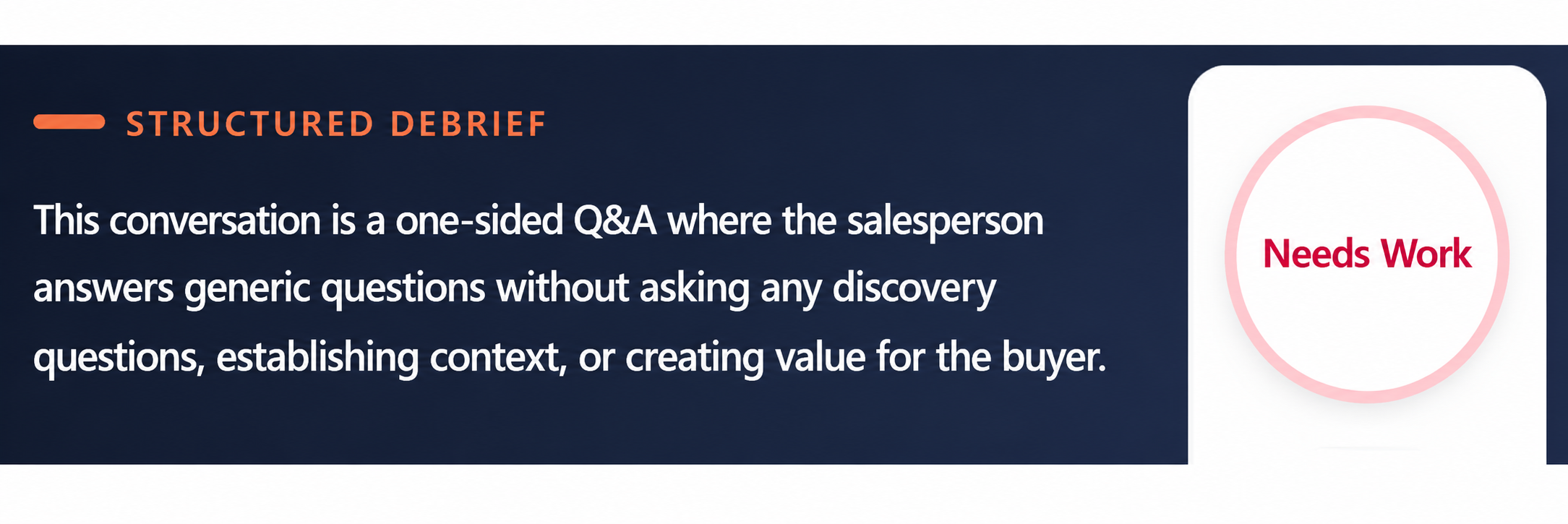
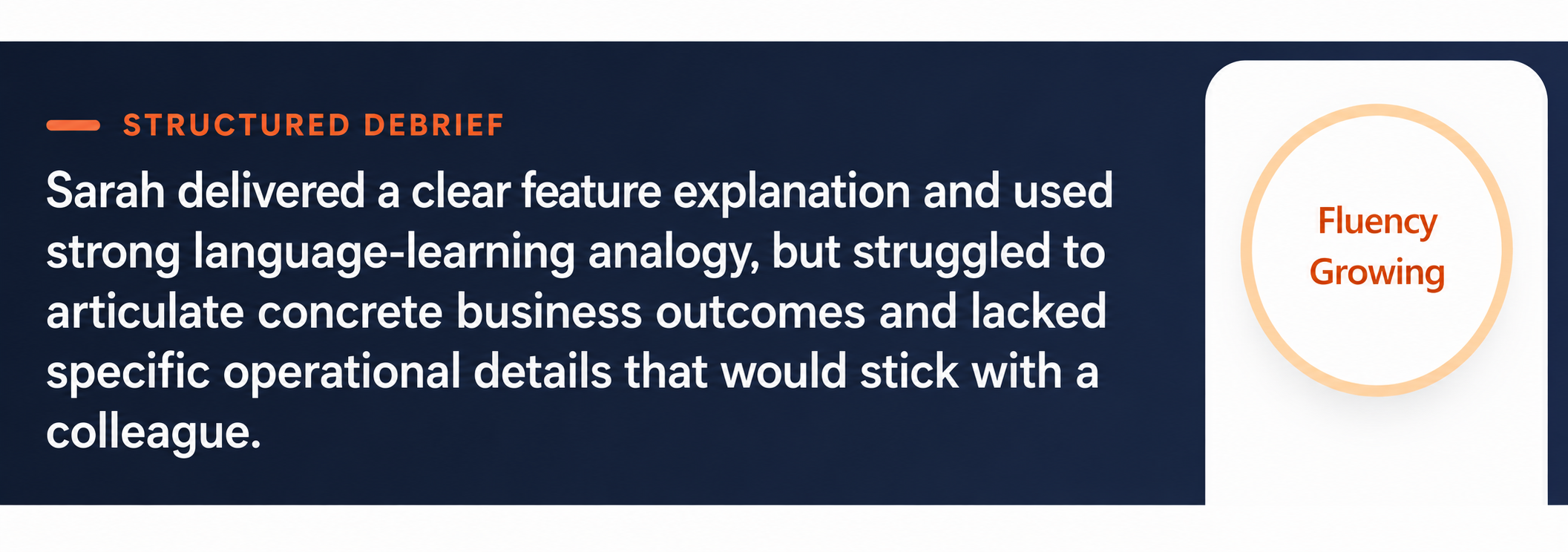


Benchmark Tracking shows how each individual and the team are performing against a defined fluency standard, making progress, performance gaps and development priorities immediately visible.

Practice can most easily be measured downstream by the number of scheduled meetings being booked. You can then assess conversation quality and more detailed execution criteria, such as the quality of information being gathered.

This is an example of a Month 1 (20 Working Days) Onboarding Path

These are the 4 Master Commercial Execution Paths for practice and fluency development, to certification level.

These are some of the Practice Studios.

This is an example of a Practice screen the users works in.

Your studio generates detailed personas for your business / product that salesperson interacts with during the simulated practices.


The Conversation Analyser can take notes and analyse to s standard, transcripts of recorded meetings and calls.

The Deal Clinic diagnoses opportunities on 3 main criteria: FIT-VALUE-Risk. We build customised “deal scans” for you.
 This is an example of a Deal Diagnostic Readout from the Deal Clinic:

Examples of Coaching Preparation Reports for the Manager Per Salesperson:


These are examples of the Feedback the salesperson uses to sharpen their fluency. The scores in the example are out of 10.


Questions & Answers
1If you are a full-time sales leader of a team ...
Unless you have an enablement function, you get caught between being that function and the "day job". We free up your time to do the managing and coaching you'd love to be doing.
2If you are a Player-Manager ...
You already have too many responsibilities, let alone provide enablement and related support. So our platform does that for you.
3If you are managing a CEO or founder-led sales team ...
Now you can provide your sellers with continuous enablement but also do something else that is vital - transfer your expertise and "expert reasoning" to the team.
4If you are a first time sales manager ...
Don't wait for experience to teach you - there is no longer any need.
Lead your team with clarity from day one - and give them a company-customised enablement capability.
5If you are a CCO or equivalent managing the sales manager team ...
You want your managers to "coach", but you know it doesn't really happen. Now you can equip them to diagnose, train and coach, with friction or time overhead.
6Why do sales teams struggle to improve execution?
Because to capture and codify the raw material (conversations) and turn them into useable intelligence cannot be done by one or even many persons. You simply need the tooling.
7Will this add another layer of work for managers?
No. It's called Execution Intelligence because it replace the data capture, analysis and "dot connecting" with a lever.
8What exactly is Execution Intelligence?
It's the signals extracted from any form of conversation that - based on standards - detects gaps, and enables the manager to make accurate decisions and act. We call it the Detect-Decide-Do principle.
9Is there much set up and who does that?
We do the set up for you behind the scenes. This is not a "sales project".
